Schedule a consult

FREE COURSES

Non-Verbal Communication

Learn persuasive non-verbal communication skills that encourage others to do things you need them to do.
Take Free Course

Non-Verbal Communication Training

SLIDES, EXERCISES & VIDEO RESOURCES

It’s been said that it’s not what you say, but how you say it that matters. And how you say things is not just about your vocal qualities but also your body language, facial expressions, hand gestures, and use of space. Whether it’s networking, sales, delivering presentations, or managing projects, your body language, tone, dress, and expressions can significantly impact how you are perceived (whether you like it or not). This non-verbal communication course teaches you the fundamentals of creating the right perception with your non-verbal communication.

This program is designed to introduce you to the principles of persuasive non-verbal communication so you can use body language, facial expression, and vocal cues to persuade others. We will teach you how to; identify persuasive body language and gestures, make a great first impression, create the visual and audible perception you want, and use your body and voice to connect with others.

What’s included?
  • Persuasive non-verbal communication seminar delivered by a certified adult educator with 15 years of sales and/or procurement experience
  • Non-verbal communication planning templates and checklists

What You Earn

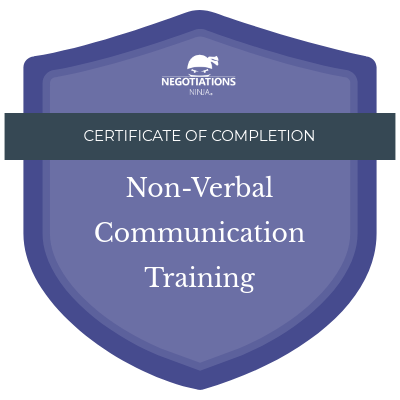
Complete the Non-Verbal Communication Certificate and earn a verified digital badge from Negotiations Ninja. Add it to LinkedIn, social network, or your resume to showcase your negotiation expertise and stand out.

Non-Verbal Communication Training Badge

— Non-Verbal Communication Training Badge

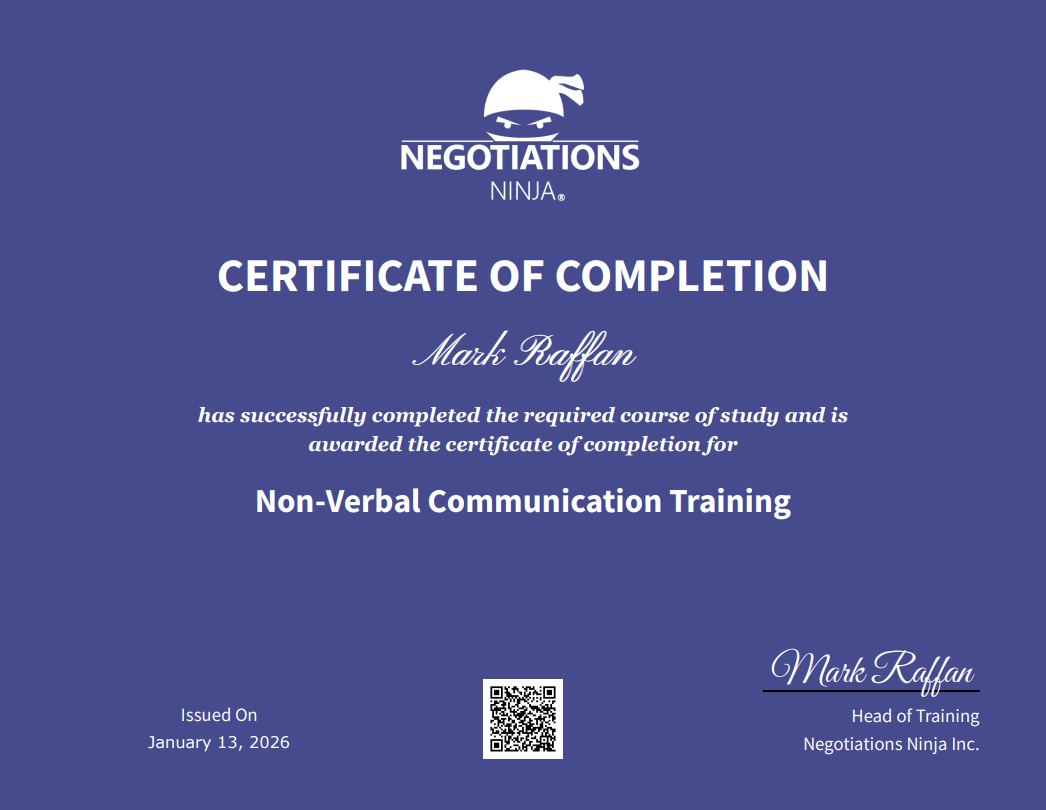
Non-Verbal Communication Training Certificate

— Non-Verbal Communication Training Certificate


Non-Verbal Communication Training

INTRODUCTION & MODULE 1 | 9 MINUTES

In this introductory section, you will get a clear overview of the course and why non-verbal communication is a decisive factor in high-stakes conversations. You will learn the foundations of non-verbal influence, including how posture, facial expressions, eye contact, tone, pace, and presence shape credibility and trust, along with the core categories of non-verbal communication and why congruence matters when your words must match your signals. You will also complete a simple self-awareness exercise using a recording of yourself to identify one high-impact behavior to improve right away.

MODULE 2 & 3| 15 MINUTES

In Modules 2 and 3, you will learn why non-verbal communication is a power skill in high-stakes environments and how influence often begins before you speak, since people form fast judgments from posture, facial expressions, presence, tone, and gestures. You will explore how these signals shape trust, credibility, and authority, why words without non-verbal support can fall flat, and how leaders set the emotional tone through small cues. You will also learn how to decode others by establishing a baseline, watching for deviations, interpreting signals within context, and looking for clusters of cues, with practical exercises using recorded meetings with sound off and on to spot congruence and incongruence.

MODULE 4,5 & 6| 17 MINUTES

In Modules 4, 5, and 6, you will learn to use posture, hand gestures, and movement as persuasive non-verbal tools in high-stakes situations. You will focus on posture and presence by using upright, grounded, and open body language, keeping hands visible to support trust, and using stillness to signal control, plus you will practice a power pose and quick posture scans. You will then learn to use gestures intentionally by understanding illustrators, regulators, and adapters, applying high-impact gestures like the steeple, open palm, and precision grip with timing and moderation, and completing a gesture audit while staying aware of cultural and industry context.

Finally, you will learn to move with purpose by anchoring on key points, avoiding aimless movement, using space effectively in-person or on camera, and using subtle mirroring to build rapport, supported by an exercise to map your environment and practice one intentional movement pattern.

MODULE 7,8 & 9| 20 MINUTES

In Modules 7, 8, and 9, you will learn how to use attire, facial expressions, and vocal delivery as persuasive non-verbal tools in high-stakes settings. You will learn how clothing and grooming shape first impressions and credibility, how to dress intentionally for the audience and environment, and how details like fit and color can influence perception, supported by a mirror self-audit and a small upgrade exercise.

You will then learn how your face constantly signals emotion by improving awareness of default expressions, using natural eye contact, keeping smiles sincere, reducing tension cues, and practicing a calm and engaged listening face through a feedback drill and recorded review. Finally, you will strengthen your voice by managing tone, pitch, pacing, pauses, and volume, reducing filler words, upspeak, and nervous laughter, and practicing these skills through simple read-aloud exercises.

MODULE 10,11 & 12| 16 MINUTES

In Modules 10, 11, and 12, you will learn how personal space and proximity shape perception by understanding common distance zones, using positioning and seating to signal collaboration or confrontation, and staying aware that proxemics changes across cultures, industries, and gender norms, supported by a short reflection exercise for your next interaction.

You will also learn how to read the room by assessing mood, tracking engagement shifts, spotting key influencers and dissenters, and noticing micro reactions early so you can adjust in real time and, if needed, address concerns directly. Finally, you will wrap the course with a focus on ongoing practice by using these skills intentionally in every high-stakes setting, prioritizing presence with purpose over perfection, and improving through feedback, coaching, and recording and reviewing your own non-verbal behavior.


Frequently Asked Questions

What is the Non-Verbal Communication Course?

The Non-Verbal Communication Course is a program that introduces you to persuasive non-verbal communication. We teach you how to persuade and influence others through the power of your body language, facial expressions, vocal cues and tonality, and more. 

Why is non-verbal communication training important?

Up to 90% of all communication is non-verbal; this means your words are responsible for only a fraction of what you communicate. The subtext of your interactions is far more critical than the actual words spoken. For this reason, non-verbal communication training is essential to your success in business. 

What should I expect from the Non-Verbal Communication Course?

This course focuses on developing the essential persuasive non-verbal communication skills for dealing with others successfully. In training, we will cover:

  • The Fundamentals of Non-Verbal Communication
  • Persuasive Body Language and Hand Gestures
  • How Your Appearance Influences Your Audience and How to Dress Persuasively
  • How to Use Persuasive Facial Expressions to Influence Others
  • How to Develop a Persuasive Vocal Tone
  • Personal Space Awareness


What does the Non-Verbal Communication Course teach?

We will teach you various non-verbal communication concepts and principles. Upon course completion, you will understand:


  • How to Recognize Persuasive Body Language and Gestures
  • How to Make an Excellent First Impression on Prospective Clients and Customers 
  • How to Create the Visual and Audible Perception You Want
  • How to Effectively Use Your Body and Voice to Establish an Authentic Connection with Someone
How does non-verbal communication training improve sales performance?

Non-verbal training enhances your communication skills; this can improve your sales performance in many ways, such as:


  • Better delivery when you pitch your products, services, ideas, etc.
  • Convincing prospects to choose you over your competitors
  • Developing a connection with prospects so they trust and, as a result, want to do business with you
How does non-verbal communication training improve your negotiations?

Successful negotiations are found in the details of an interaction. That’s why non-verbal communication training is important. Simple acts such as nodding your head or holding eye contact can alleviate social pressure and establish connections—even in a disagreement. Not knowing these simple body language secrets can ruin a potentially high-yielding negotiation; for this reason, non-verbal communication training is crucial for your long-term negotiation success. 

How does non-verbal communication training improve conflict resolution?

Crossed arms, pursed lips, a furrowed brow, etc., indicate someone may be upset. To resolve such conflict, you must first be aware of its non-verbal presence within an interaction. Knowing different body language signs  will put you in the driver’s seat of resolving conflicts. We teach you how to identify and neutralize defensive body language in our non-verbal communication training.

How does non-verbal communication training improve persuasion and influence?

Non-verbal training makes you a more effective communicator. As such, you can get your point across clearly, concisely, and efficiently. Your ability to communicate your ideas and influence others depends on how you use your:

  1. Vocal Tone
  2. Body Language
  3. Facial Expressions
  4. Space Utilization
  5. Hand Gestures
  6. Wardrobe and Physical Appearance

All of these factors work in unison to influence others, whether you’re networking, selling, giving a speech, or managing a project with colleagues. And in our Non-Verbal Communication Course, we teach you how to use these elements to your advantage. 

What are the important steps to improve non-verbal communication?

You must first understand how non-verbal communication affects your persuasion ability. Once familiar with its importance, you identify and choose several non-verbal communication techniques to practice to help you become more persuasive. This process is covered in-depth in our Non-Verbal Communication Course. 

How can I improve my non-verbal communication skills at work?

By understanding the fundamentals of what creates positive communication in the workplace and practicing those principles. In the Non-Verbal Communication Course, we teach you the fundamentals of understanding and implementing the proper subtext in your workplace communications. You will receive non-verbal communication planning templates and checklists for your skill development. 

What is the cost of the non-verbal communication training course?

It is 100% free. Click here to get access

How do you train your body language?

Through time and practice. We give you the tools, techniques, and principles to understand non-verbal communication. However, it’s up to you and your team to put these skills into practice until you develop your proficiency in using them.

Can your non-verbal communication training experts come to our office?

Yes. We provide numerous ways for our training experts to teach and educate your team. First is our in-person private closed-enrollment events, where one of our training experts will deliver training at your office (please note that travel expenses are extra). Second is our private virtual closed-enrollment events, where one of our training experts will deliver training to your team over Zoom. Third is our public in-person open-enrollment event, which takes place at the University of Calgary campus in downtown Calgary, where anyone can join. And fourth is our public virtual open-enrollment training delivered over Zoom, where anyone can join from anywhere as long as they have a computer and internet connection. 

Who Can Use These Free Courses?


  • Executives, managers, and high-potential leaders from a range of functional areas such as sales, marketing, procurement, project management, and operations
  • Experienced business-owners, entrepreneurs, and franchise owners
  • Professionals involved in complex stakeholder relations
  • Professionals involved in mergers and acquisitions

Learning Outcomes

Upon completing this program, you will be able to:


  • Understand how non-verbal communication affects communication and persuasion;
  • Identify, select, and use several non-verbal communication techniques and practices that make you more persuasive;
  • Develop better interpersonal skills to use in your professional life;
  • Manage concessions and reduce the need to give more away than you should;
  • Distinguish and express the tactical and behavioral skills required to enhance value, extract value, and negotiate confidently

Curriculum

In the training, we focus on the development of key skills related to building persuasive non-verbal communication where we will cover:


  • What is Non-Verbal Communication?
  • Persuasive Body Language and Hand Gestures
  • Dressing Persuasively for Your Audience
  • How to Identify and Use Persuasive Facial Expressions
  • How to Develop Persuasive Vocal Dynamics
  • Personal Space Awareness
Testimonials for Non-verbal Communication Training

“Mark gave us tools around non-verbal communication that we could use to get alignment internally.”

— Michael Kaeding, PEng